Food-Grade, BPA-Free & Dishwasher-Safe: A Buyer's Guide to Plastic Storage Materials
Monica Zhang
6/26/2026
Introduction
A few months ago, a buyer from Taiwan contacted me about a new canister collection for the US market.
The samples looked great. The transparency was excellent. Pricing was within budget.
Then she asked one simple question:
"Can these containers go into the dishwasher?"
That single question completely changed the material discussion.
The product had originally been designed around standard clear PET — the material used in most pantry organizers and storage bins. But dishwasher compatibility introduces an entirely different set of engineering requirements. And that's where many sourcing conversations become confusing.
Terms like food-grade, BPA-free, and dishwasher-safe appear constantly in product listings and supplier catalogs. They sound reassuring. But they mean very different things — and understanding the distinction will help you make better material decisions before a sample is ever produced.
1. "Food-Grade" Is a Starting Point, Not a Guarantee
The term "food-grade" means the material has been evaluated and found acceptable for contact with food under normal use conditions.
For PET and PP — the two most common materials used in storage organizers — this baseline is well established. Virgin PET resin has a long history of compliance with FDA requirements in the United States and food-contact regulations across Europe.
However, many buyers misunderstand one important point:
Food-grade does not automatically mean certified.
A product can be manufactured from food-grade material without undergoing third-party testing.
Whether certification is required depends largely on the retail channel.
For most wholesale buyers, importers, distributors, and e-commerce sellers, material compliance is generally sufficient.
For large retail chains and national retailers, documentation often becomes mandatory.
In our experience, third-party testing is most commonly requested by:
· Major supermarket chains
· National home goods retailers
· Big-box retailers
· Private-label programs with internal compliance standards
In these cases, testing costs are normally handled separately as part of the product development budget rather than included in the unit price.
For many growing brands, material compliance comes first. Formal testing requirements usually follow as retail channels become larger and more sophisticated.
2. What Retail Buyers Usually Ask For
For buyers supplying major retail channels, compliance documentation typically includes:
✔ FDA food-contact compliance (United States)
✔ LFGB testing (European Union)
✔ BPA-free material declaration
✔ Material traceability documentation
✔ Third-party laboratory reports where required
Not every project requires every document.
The correct compliance package depends on the retail channel, product category, and customer requirements.
For major retailers — including large supermarket chains, big-box stores, and national home goods retailers — third-party testing reports are standard practice. Many large retailers maintain their own vendor compliance programs with specific testing standards and approved laboratory requirements.
For e-commerce channels, third-party testing is generally not a platform requirement. Two exceptions are worth noting: products categorized as children's items on platforms such as Amazon may trigger mandatory certification requirements, and sellers making specific compliance claims in their listings — such as "FDA approved" or "LFGB certified" — will need documentation to support those claims.
In practical terms: third-party testing becomes necessary when supplying major retail accounts or when making specific compliance claims in product listings. For standard wholesale and e-commerce orders, baseline material compliance is typically sufficient to start.
Understanding these expectations before tooling and production begin helps avoid delays, unexpected testing costs, and last-minute compliance issues.
3. "BPA-Free" — What It Means for PET and PP
BPA, or bisphenol A, is a chemical compound historically used in polycarbonate plastics and certain epoxy resins.
As consumer awareness increased, BPA-free claims became a standard expectation across many household product categories.
For buyers sourcing PET and PP storage products, the good news is simple:
PET and PP do not contain BPA.
A clear PET storage bin or PP organizer is inherently BPA-free because of the chemistry of the material itself.
This means BPA-free is not usually a premium feature within these material categories.
It is simply the baseline.
Where BPA considerations occasionally become relevant is when buyers request extremely rigid, glass-like transparent products and alternative materials enter the discussion.
For food-contact products intended for North American or European markets, confirming the material composition remains a sensible due-diligence step.
4. "Dishwasher-Safe" — The Question That Changes Everything
This is where the material conversation becomes significantly more nuanced.
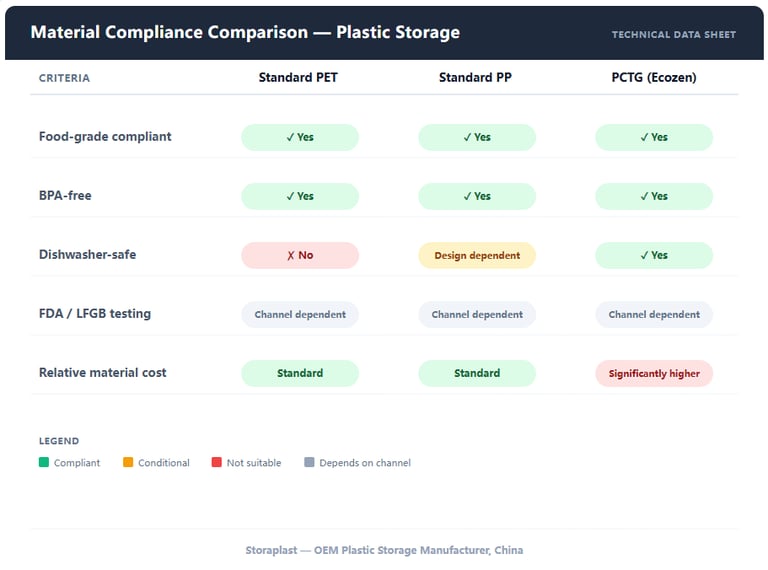
Standard food-grade PET has a heat deflection temperature of approximately 60°C under load. Household dishwashers typically operate between 55°C and 75°C during the wash cycle, with heated drying reaching higher temperatures — conditions that can cause standard PET to warp or lose clarity over repeated cycles.
The result can include:
Warping — Permanent shape deformation.
Loss of Optical Clarity — Reduced transparency after repeated exposure.
Surface Distortion — Visible changes in appearance and finish.
In practical terms:
Standard clear PET storage products are designed for hand washing, not dishwasher use.
This is not a quality problem.
It is simply a material characteristic.
The same properties that make PET ideal for pantry organization, refrigerator storage, and premium transparency also limit its performance under sustained high temperatures.
PP generally provides better heat resistance than PET. However, dishwasher performance still depends on wall thickness, structural design, and repeated exposure conditions. PP products are sometimes labeled top-rack dishwasher safe under controlled conditions, but this should be validated for each specific product design rather than assumed.
For products where dishwasher compatibility is genuinely required, alternative materials become necessary.
5. PCTG and the Real Cost of Dishwasher Compatibility
When the Taiwan buyer confirmed that dishwasher compatibility was essential for her canister collection, we began evaluating alternative materials.
One of the most widely recognized premium solutions is PCTG, including Ecozen® materials produced by SK Chemicals in South Korea.
Compared with standard PET, PCTG offers:
✔ Higher heat resistance
✔ Excellent transparency
✔ Food-contact suitability
✔ Improved dishwasher durability
From a performance perspective, PCTG is excellent.
The challenge is cost.
Over the years, I have seen relatively few projects move from PET to Ecozen PCTG. Not because buyers disliked the material — quite the opposite. The performance was impressive. The limiting factor was usually economics.
For most pantry organizers and storage bins, consumers are comfortable with hand washing. In these applications, PET provides a much stronger balance between performance and cost.
For premium canisters positioned around convenience, durability, and dishwasher compatibility, PCTG becomes far easier to justify.
Transparent-grade ABS is another alternative sometimes considered for higher heat resistance applications, although it is less commonly specified for food-contact storage compared with PCTG.
One important industry reality is worth mentioning:
The vast majority of clear pantry organizers and storage bins sold through mainstream retail channels are manufactured from PET or PP.
PCTG remains a premium niche material used primarily when dishwasher compatibility becomes a genuine product requirement.
6. PET vs PCTG — Which One Should You Choose?
This is one of the most common questions buyers ask after learning about material options.
The answer depends entirely on product positioning.
Choose PET if:
✔ Cost efficiency matters
✔ Pantry and fridge organization are the primary applications
✔ Hand washing is acceptable
✔ High transparency is important
Choose PCTG if:
✔ Dishwasher compatibility is a core selling feature
✔ Premium retail positioning is required
✔ Higher material costs are acceptable
✔ Long-term heat resistance is essential
Neither material is universally better. The best choice is the one that matches the actual use case and price point of the product.
7. A Practical Compliance Reference
8. Frequently Asked Questions
Q: Is PET food-safe? A: Yes. Virgin PET is widely used for food-contact applications and is commonly accepted under FDA and EU food-contact frameworks.
Q: Is PET BPA-free? A: Yes. PET does not contain BPA.
Q: Can PET go in the dishwasher? A: Generally no. Standard PET products are designed for hand washing. Dishwasher temperatures can cause warping and reduced clarity over repeated cycles.
Q: What material is best for dishwasher-safe clear storage? A: PCTG, including Ecozen®, is one of the most widely used premium options for dishwasher-compatible transparent storage products.
Q: Do I need FDA or LFGB reports? A: That depends on your retail channel. Large retailers typically require documentation. Smaller wholesale and e-commerce orders often do not.
Q: How much more expensive is PCTG than PET? A: PCTG carries a meaningful material premium over PET. The exact difference varies by project, but buyers should expect higher material costs that must be reflected in pricing and margin planning.
Q: PET vs PCTG — which should I choose? A: Choose PET for pantry organization, fridge storage, and cost-efficient clear products. Choose PCTG when dishwasher compatibility and heat resistance are essential product requirements.
Q: What is the minimum order for PCTG products? A: PCTG projects typically require new tooling or significant mold modifications, so standard OEM MOQ of 3,000 pcs per style applies. Contact us to discuss your specific requirements.
Every Material Choice Involves Trade-Offs
Every material decision involves balancing cost, performance, compliance requirements, and consumer expectations.
The best material is rarely the most expensive one. It is the material that best matches the product's positioning and intended use.
At Storaplast, we work with buyers to evaluate these trade-offs objectively, helping brands choose the right material for the right application rather than simply the most technically advanced option.
If you are evaluating PET, PP, PCTG, or other transparent plastics for your next storage collection, we would be happy to share our manufacturing experience and discuss the practical implications of each material choice.
Explore our clear PET storage collections → storaplast.com/clear-pet-turntable-organizer
Direct inquiry: WhatsApp Monica at +86 159 6894 1087 — typical response within 24 hours.
About the Author
Monica | Storaplast
More than 10 years of experience in OEM production management for international home organization and retail brands. Specializing in plastic storage solutions, private-label development, material selection, and scalable manufacturing partnerships.